Wednesday, August 1, 2018

First Look: Srixon Soft Feel Balls

Golfers have a stated preference for balls which jump off the tee but sit and obey around the green. While premium, tour level balls still provide the best combination of those performance attributes, ball companies realize there’s a viable market ripe with value-conscious consumers whose games don’t demand the absolute zenith of ball technology.

Now on its 11th generation, Srixon’s Soft Feel (MAP $19.99/doz) is touted as longer, straighter and softer than previous versions – and better in every facet when compared to similar offerings from Titleist and Callaway to boot.

QUICK LOOK

Improved tee ball distance is the result of Srixon’s E.G.G. (Energetic Gradient Growth) core. The gradient element is such that the core becomes progressively firmer toward the periphery yet remains sufficiently soft in the middle. It’s a bit like adding a layer without actually adding a layer.  Lower compression cores translate to lower driver spin, which for many players leads to increased carry distance.

The new 338 Speed Dimple Pattern is more aerodynamic, which promotes straighter ball flight, particularly in windy conditions. Again, Srixon’s testing indicates the increased accuracy of the Soft Feel doesn’t come at the expense of distance.

Historically, 2-piece balls have offered two primary benefits. One is price, and the other is reasonable distance off the tee. The primary opportunity cost was a distinct lack of spin around the greens and a sensation at impact which was anything but soft. Srixon’s new Ionomer cover is thinner (0.063”), softer (hardness rating of 57) and offers a bit more bite on chips and pitches.

COMPARATIVE DATA

No doubt, every OEM seems to find a way to either create or massage information in such a way as to allow its products to “win” and some percentage of consumers will only focus on what the numbers don’t say, rather than what they do.

That said, Srixon contracted with independent testing facility, Golf Laboratories, and based on information gathered in robot testing, the Soft Feel ball is longer, straighter and produces more greenside spin than both the Titleist Tour Soft ($34.99/doz) and Callaway’s Supersoft ($21.99/doz.) That said, while some will delve deep into the weeds arguing winners and losers based on any number of included (or excluded) data points – it’s safe to suggest the Soft Feel is certainly a comparable ball and at a lower price, it could be argued presents a better value.

Specifically, Golf Laboratories testing showed Soft Feel to produce nearly a yard more total distance off the driver. The findings were based on an 84 MPH swing speed with a Callaway Rogue 10.5 R-Flex driver.

In iron testing, the Soft Feel proved to be both several yards longer and more accurate than the Tour Soft and nearly as long, but more accurate than the Supersoft. The salient selling point for Srixon being that improved accuracy and increased consistency should invariably lead to better performance. Testing for this portion utilized the TaylorMade M4 7-iron with a steel, R-Flex shaft, swung at 75 MPH.

Regarding greenside spin, the Soft Feel spun marginally more than Callaway’s Supersoft and nearly 14% more spin than the Titleist Tour Soft. This data was based on 36 MPH of clubhead speed and the wedge used was a Titleist SM6, 56°

The Srixon Soft Feel series is currently available in two models – Soft Feel and Soft Feel Lady with two colorways per model. The Soft Feel comes in Soft White and Tour Yellow while the Soft Feel Lady is available in Tour White or Passion Pink.

There’s certainly a market for a ball with as much performance as many amateurs need sans the premium price tag and given how competitive the premium ball market is, it seems OEMs are shifting away from the everyone should play a tour ball marketing approach to one differentiated more by player needs.

As always, tell us what you think.

Pricing and Availability

The Srixon Soft Feel golf ball is available now. Retail price is $19.99 per dozen.


from MyGolfSpy https://ift.tt/2vynvpV

Strategic Jujitsu: New Business Models for Early Stage Entrepreneurs

jujitsu small business strategyJujitsu is the martial art whereby you use your opponent’s strengths or your own (oft-perceived) weakness to your advantage.

Hmmm. Sounds like a technique entrepreneurs might want to apply to know where and how to carve out a specific market niche. Many would use it to figure out specific points of friction where your larger competitors struggle, and focus there to compete with them.

But that tactic works only for a competitive landscape that no longer exists.

Jujitsu remains a critical technique. But one lesson of explosive growth companies is that the zero-sum game between you and your larger opponent is no longer the game to play. The rules underlying that game and the competitive landscape it reflects have changed.

Let’s explore how and what it means to you.

A changed competitive world and what it means to you

Here’s something we all know: Industry boundaries are blurring.

Think of Tencent or Tesla—they’re hard to categorize. The former provides services from banking to media, and gaming to social media, while the latter produces cars as it builds energy storage capabilities for a variety of high-energy needs.

Our future is a world of “business ecosystems,” reflecting the bundling and unbundling of value chains and the blurring of industry boundaries.

As boundaries blur, companies who’ve long captured a disproportionate percentage of economic profit within traditional industries face off against companies they’d previously never viewed as competitors. Namely, you.

And here it gets interesting. The new questions become: What’s common to these ecosystems and to the explosive growth models that underlie them, and what role might you play to help orchestrate those ecosystems in a way that drives explosive growth for everyone, big and (still) small?

It’s the identification of “what is common” and the underlying lessons that forms the foundation of the new rules of our changed competitive world and, consequently, the pragmatic steps you can take to become one of those explosive growth companies.

Let’s see how.

3 steps to take as an early stage entrepreneur

1. Plant a flag on a “problem” to own—and own it.

Explosive growth has always come from identifying points of friction or market breakdown and orchestrating capabilities (skill sets, behavioral patterns, and technology assets) to overcome them.

A critical note: Planting a flag has little to do with the existing set of products and services that a firm currently offers. Recall that the majority of businesses are optimized for a world that no longer exists.

But don’t take my word for it. It’s evidenced by the topple rate—the rate at which companies fall from their once competitive position. Over 60 percent of companies on the S&P 500 in the past 15 years have gone bankrupt, been acquired, or fallen off the S&P ranking table, and the pace is accelerating.

Most large organizations look for growth for their existing products or services—an inside-out perspective driven by the question, How do we sell more of what we already have, just differently?

Figuring out what flag to plant requires starting from an outside-in perspective, working from the critical points of friction or market breakdown and what’s required to tackle those. Then, and only then, figure out what products and services are needed and, critically, who provides them (a preview of steps 2 and 3).

Here’s the reality and the beauty of the new models: You don’t need to offer all the products and services critical to protecting this flag, just those critical to unlocking a disproportionate amount of value that the flag represents. How? Well, that’s the point of the second step.

2. Clarify—and mobilize around—the new 20 percent.

Capabilities (skill sets, behavioral profiles, and technology assets) are the infrastructure of execution. No capabilities, no execution. No execution, no customers. No customers, no business. Pretty straightforward—until it’s not.

20 percent of any organization’s capabilities drives roughly 70 percent of the value it delivers. A changed competitive world requires a new 20 percent of capabilities critical to capture the 70 percent of new value.

The question becomes: What is that new 20 percent, and what do you do about it?

This is where and why large companies become so important to small companies, and critically, you to them. They likely don’t have the new 20 percent critical to capture the new 70 percent of value, nor is it easy for them to do so. But you can, which is where and why you become instrumental to the new business model (or how firms orchestrate their capabilities to deliver value).

Which takes us to the third step.

3. Orchestrate your ecosystem.

Orchestrating your ecosystem involves figuring out what is the “new 20 percent” not only of yours, but those of your partners, and figuring out how to harness—orchestrate—all of these capabilities to capture new sources of value in new ways.

Many people characterize business ecosystems as a set of partners to engage with. But there’s a more pragmatic definition that underlies explosive growth models: The orchestration of capabilities from different parties around the new sources of value to create.

This isn’t a partnership play. This is an embeddedness play—the orchestration of capabilities whereby everyone engaged shares risks and rewards together.

Becoming essential

There’s a cult movie classic, “The Gods Must be Crazy,” with a line in it that I refer to often when working with both large and small organizations:

“Things that were yesterday unknown have today become a necessity.”

The key lesson for entrepreneurs is to become that necessity of the new 20 percent of capabilities critical to capture 85 percent of the economic value that makes up any and all business ecosystems.

Do you want explosive growth? Then focus on how to execute on this lesson around which the ecosystem will be orchestrated.

What’s in your new 20 percent?


from Bplans Articles https://ift.tt/2MaQaYW

Monday, July 30, 2018

Strategy Is Useless Without Execution

strategy and tacticsIt happens all the time. You take your team away from the routine for a few hours, brainstorm, and develop a brilliant new strategy for your business. And when you all get back into the routine, the routine wins and strategy loses. Nothing changes.

The plan was brilliant on the whiteboard but never got to the real world. What happened?

Download the Business Plan Template today!

Tactics are the measurable action steps toward a larger strategic goal

Your business strategy is useless without execution. Don’t leave that whiteboard without developing key tactics. Make sure the execution tactics you choose are directly in service of your strategic goal. For every action you take, you should be able to say how it relates to your overall business strategy.

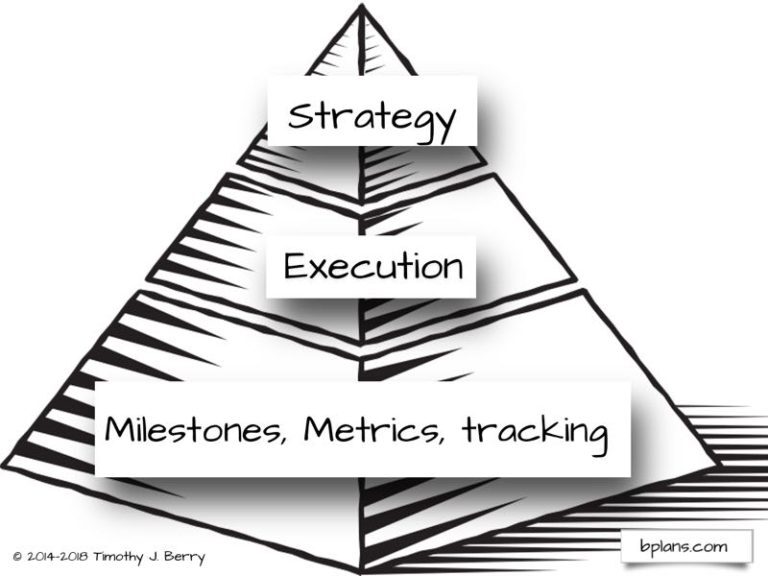
I use the image of the pyramid below to explain strategy, tactics, and execution.

  • Strategy is at the top of a pyramid. Strategy is focus. It’s a collection of choices that narrow your aim to target markets and with product or service offerings that match both the target market and your own identity. Strategy is, therefore, deciding what you are not doing; like who isn’t in your market and what products you aren’t going to offer.
  • Tactics make up the second level of the pyramid. They are more specific and practical decisions taken to execute the strategy. For example, choosing to target the high-end less price sensitive market segment is strategy. Pricing is tactic. Choice of channels and marketing messages are tactics.
  • Concrete specifics, milestones, budgets, tasks, responsibility assignments, tracking, and following up make up the third level, at the bottom of the pyramid. They have to be defined in detail and they should also be measurable.
  • Execution is a good word for both of the lower two levels of the pyramid, taken together. Execution includes the tactics and the concrete specifics.

For example, in How to Develop Your Business Strategy, posted here a few days ago, I used a bicycle store as an example of how strategy leads logically to execution. Let’s start with strategy:

Imagine the difference between a bicycle retail store owned and operated by a former professional bike racer, and another one owned and operated by a couple with children who like bicycles as a family activity.

The first one will probably stock and sell expensive, sophisticated bicycles for the racing enthusiast and extreme long-distance or mountain biking hobbyist. The second will probably emphasize bicycles for children, bike trailers, carriers, and accessories for families.

Whichever direction the bike store takes is strategy, and it won’t work without execution, the tactics. In this case, the tactics would include what to stock in the store and what not to stock, general pricing level, promotions, bundles, participation in local events, tone and content of social media, advertising messages and media, even how to position service. And, aside from the tactics, it takes concrete specifics such as milestones (dates and deadlines) and budgets.

Execution should be strategically aligned with your goals

I’m amazed that so much of what I see written about business plans includes strategy but skips execution. In truth, the tactics are usually there, broken into sections such as the marketing plan, product plan, financial plan, and management plan. And the better business plans also include the concrete specifics, presented as major milestones, metrics, dates, budgets, and so forth. Alignment means the tactics match the strategy and the concrete specifics match the tactics.

So, the good news is that we actually do think through tactics and include them in the plan but the bad news is we don’t always articulate the relationships between the strategy and the tactics. And we don’t always add in the specifics. We lose strategic alignment, which is the coordination between your plan and execution.

What’s strategic alignment? It’s the right hand knowing—and working with—what the left hand is doing. So if the bike store owner says her business strategy is to focus on the family market, then she shouldn’t stock fancy bikes, she can’t charge upscale pricing, she can’t advertise in the extreme sports or extreme fitness websites. Her social media content is about kids and family, not racing. She takes her store to local activities like charity bike rides and school parades, not triathlons.

Lack of alignment happens way too often. I spent years consulting with Apple Computers helping dealers counter the so-called “box pushers” in big-box stores by focusing on small business and really good service.

“Strategy without execution is the slowest route to victory, and tactics without strategy is the noise before defeat.”

– Sun Tzu from “The Art of War”

However, way too often, they’d claim that as strategy in meetings but still offer only mediocre service.

The good ones remodeled their stores to add a big service counter and put employees in white coats behind the counter. And they bundled installation into sales and added white vans plastered with “another installation” banners on the side.

Strategy, tactics, and concrete specifics: The planning pyramid

So as you do your plan, think of a pyramid in which strategy is at the top, tactics in the middle, and concrete specifics including milestones, tasks, budgets, and performance metrics at the bottom.

Make sure your pyramid points line up. If you are doing a Lean Plan, leave strategy and tactics as bullet points. If you are doing a formal plan, break the tactics up into marketing, product, financial, management, and other.

Do your thinking first, for your own use; then do whatever you need to meet the requirements of the formal plan for readers outside of your own team.

How does your business use tactics to execute strategy? Tell us on Twitter @Bplans, or reach out to me directly @Timberry.


from Bplans Articles https://ift.tt/2lHLDV4

Proposed farm bill would put nutritious food further out of reach for vulnerable Americans, advocates say

By AMERICAN HEART ASSOCIATION NEWS

The House of Representative’s proposed farm bill could have far-reaching effects on Americans living with chronic diseases like heart disease and stroke, advocacy groups say.

Last month, the House released its version of the farm bill that proposed sweeping changes to hunger assistance programs, including the Supplemental Nutrition Assistance Program (SNAP).

The provisions would mean stricter work requirements and reduced funding for nutrition education initiatives. Millions would either have their benefits decreased or be cut from the program.

The House and Senate still must reconcile their versions of the farm bill. The Senate’s bipartisan proposal ensures that vulnerable populations, including children, the elderly and the disabled, still have access to SNAP benefits.

More than 40 million Americans, including an estimated 16 million children, struggle to put on the table. SNAP, formerly known as food stamps, is the nation’s most prolific anti-hunger program, serving one out of every eight Americans.

Whether temporary or chronic, research shows food insecurity is devastating for Americans struggling with serious illnesses.

SNAP is designed to help mitigate the risks of food insecurity, and has been shown to improve some health outcomes. In households that receive SNAP benefits, children have lower rates of hospitalization compared with similar households not participating in SNAP. The program has also been linked to positive health outcomes in adulthood, including reduced risk for obesity, high blood pressure, heart disease and diabetes.

Most SNAP recipients who can work do so, research shows. Among households with at least one working-age, non-disabled adult, more than half work while receiving SNAP. More than 80 percent of SNAP recipients work in the year before or after receiving SNAP, with rates being even higher for households with children.

“People don’t do anything well if they don’t have enough to eat,” said Asha Carter, community outreach specialist at D.C. Greens, a food justice nonprofit in Washington, D.C. From finding stable employment to having regular medical appointments, Carter said food insecurity should not be viewed as an isolated issue.

D.C. Greens is using input from SNAP recipients to create programs that better align with peoples’ needs. Its Produce Rx initiative, which is similar to a provision in the Senate farm bill, provides patients who are at risk or experiencing diet-related chronic illnesses with a monthly “prescription” for fresh fruits and vegetables from their health care provider that they can redeem for food at farmers markets.

Carter said the response from both SNAP recipients and physicians has been overwhelmingly positive. D.C. Greens is currently working on expanding the program by partnering with a grocery store in one of Washington, D.C.’s poorest neighborhoods.

As groups like D.C. Greens work to put healthier food within reach for vulnerable populations, nutrition groups look for solutions that encourage healthier eating habits among SNAP recipients.

“Currently, [SNAP] is sending competing messages,” said Angela Rachidi, a poverty studies research fellow at the Washington, D.C.-based American Enterprise Institute. “It’s the largest nutrition assistance program, yet it allows unhealthy products to be purchased.”

Research into SNAP diet quality is ongoing, but current literature suggests that despite the program’s documented success in reducing hunger, SNAP still needs improvements to address issues related to diet quality.

A 2012 study that analyzed the diets of 3,835 low-income adults found SNAP participants consumed 39 percent fewer whole grains, 46 percent more red meat and, among women, 61 percent more sugary beverages.

As Congress irons out the details on the future of SNAP, health groups such as the American Heart Association say cutting SNAP benefits would be devastating.

“If we truly want to see better health outcomes, we need to make nutrition a priority,” said AHA CEO Nancy Brown.

“We need a final farm bill that strongly addresses what all Americans choose to put on our plates every day.”

If you have questions or comments about this story, please email editor@heart.org.

The post Proposed farm bill would put nutritious food further out of reach for vulnerable Americans, advocates say appeared first on News on Heart.org.


from News on Heart.org https://ift.tt/2AmwZtI

Shot Scope Case Study #2: George’s Poor Greenside Play

George is a long-time user of both Shot Scope V1 and now V2. We met George when one of our team members happened to play with George at an event last month. George mentioned his scoring and handicap had climbed from 4 to 6 over the past year and that he couldn’t pinpoint the cause. George hadn’t made any significant swing changes although he did change his wedge set-up.

In 2017, Shot Scope identified poor gapping with his PW, 49°, and 56° wedges. This season, George altered his setup to use a PW, 50°, 54°, and 58°. The Shot Scope team decided to work with George on a case study and see if we could identify a cause for his increased handicap.

George’s Stats

George’s game overview shows he is now a 6 handicap, and his general game is in a good state. George mentioned that he plays 4/5 times a week (he is retired) at different courses and in competitions. He doesn’t hit the ball too far, but with 64% fairway success he is accurate with the Driver. With no obvious red flags, the team decided to look at George’s wedges, since that is the only change he has made.

Avg. Wedge Distances

As you can see from the Shot Scope V2 Data, George’s gapping has improved with the new wedge set-up. When he added the extra club, George removed his 4-iron, which he hardly used since he carries a 23° Hybrid. This was definitely the correct decision for George, and it’s great to see the difference between his 2017 and 2018 distances.

Short Game Performance

When looking into George’s short-game performance data, we found something intriguing. George uses a lot of clubs around the green, playing predominantly at a links course there should be a lot of chip and runs. He has a poor proximity to hole average with his 50°, 54°, 58°, 50°, and 23° hybrid. Those clubs account for 64% of his greenside shots. It’s possible there could be a bias towards using the new wedges at an increased frequency, and the inaccuracy could boil down to a lack of practice with the new lofts. There are obvious reasons to use high-lofted wedges around the greens; e.g., out of bunkers or other situations where obstacles must be carried, but on true links courses like the ones George plays, he could play more chip and runs. There is little reason to use the hybrid as the data suggests that George is not very good with this shot.

Short Game Potential

We sent George an example of what his short game could look like if he decided to use specific clubs for short game shots, and how without changing technique, he could improve his scoring. We are aware that there will still be an occasional need to use high-lofted clubs around the green, but most golfers can benefit from lofting down around the green.

Not only could George improve his average proximity to the hole by 2.3 feet, but he could also potentially get up and down 11.5% more often.

Showing George the potential performance of his short game should encourage him to loft down around the greens and ultimately lower his handicap. George may not be able to resist using the higher lofted clubs around the green, but that is the goal.

Recommendation

George should attempt to use his putter, PW, 9i, and 8i more around the greens and not to use the H23 or 50 at all. George should monitor his stats to see if can attain the potential usages per club and maintain the up and down ratios.

GET YOUR SHOT SCOPE GAME EVALUATION

Would you like to take part in a Shot Scope Case Study? If you are a Shot Scope user with over 15 rounds in your account, enter your details below – including handicap, location, and the area of the game you think requires work. Shot Scope will select different users and compile reports.


from MyGolfSpy https://ift.tt/2M27a3u

5 Things to Consider When Opening a Car Dealership

starting a car dealership businessOpening a car dealership requires careful planning. Aspiring dealers must take into account the specific legal requirements they will need to comply with to open a dealership in their state.

You must also consider other aspects such as your local market, whether to offer new and/or used cars, what startup expenses you will be facing, and how to develop a solid business plan. You’ll need to account for all of these areas and more if you want your business to take off strong and keep going for a long time.

For a list of the most important things to consider when opening a car dealership, read on!

Download the Business Plan Template today!

1. Dealership location

The location of your dealership has an impact on the number of sales and profit you make in a given year. Some states are more profitable and provide a better business climate than others.

What makes a state a good place to open a dealership? Average yearly sales, the costs associated with opening the dealership, as well as average payroll costs and weekly employee salaries in your area, are all factors that you need to consider.

At the same time, there are also some downsides to opening a dealership in the most profitable states. For example, despite great demand in many of these states, business conditions are not necessarily always optimal or easy (among other factors, you need to consider GDP growth, annual payroll expenses, and crime rate). And what’s more, if you do open your dealership in one of these business-friendly states, you will contend with plenty of competition.

In picking your dealership location, you must also think about what kind of dealership you wish to open. The National Automobile Dealers Association’s (NADA) midyear and annual reports can offer you plenty of information to make an informed choice.

2. Type of dealership

Do you know what kind of dealership you want to open? Will you be opening a new (or franchised) vehicle dealership, or will you specialize in used vehicles—or perhaps both? You could also focus on offering electric vehicles, luxury vehicles, or primarily foreign vehicles. This is related to the location of your business and your target audience.

Some states, such as Florida, are known for their preference for Asian cars. And when it comes to used cars, while the majority of states have a clear preference for pickups, other states prefer SUVs and more compact cars instead. In other words, understanding local tastes will be essential to your success.

An additional consideration you could also have at this point is whether you would want to include a service department to offer maintenance and repair work. According to the NADA data report, dealership service and parts sales across the U.S. have nearly doubled over the last eight years, resulting in a total of $114.15 billion of sales for all new-vehicle dealerships. It could be a source of additional income for your dealership.

The important thing to bear in mind here is that whatever you choose will determine the course of your business. For example, opening a new vehicle dealership will require more financing, while a used dealership will require less financing but is also likely to yield fewer profits.

3. Business and financial plan

Your business and financial plans are two other important pieces of the dealership puzzle. Ultimately, these two will be informed by the choices you make with regards to where and what kind of dealership you wish to open. Based on that, you start to develop your plans for how you will run the business, from A to Z, and how you will finance it.

To develop a sound business plan, you will need to reflect on and determine:

If you’ve never developed a business plan before, it may be wise to consult specialists on the issue, or at least take a look at a sample business plan to see how they’re structured.

There are different kinds of business plans too, so think about why you need one—to get a bank loan, outside investment, or as an internal strategic plan to guide your growth. Any money you invest in developing a business is well-spent and will likely help you save a lot more down the road by reducing trials and errors you may make due to lack of strategy or experience.

The above is also true for your financial plan. Moreover, if you plan on looking for investors or applying for a loan to get your dealership rolling, you will be asked to present detailed and comprehensive business and financial plans. To make a rough calculation of your startup costs, try the SBA’s startup costs spreadsheet.

4. Licensing requirements

To open a dealership in any state, you will need to obtain a business license allowing you to sell vehicles of a particular kind. License requirements vary significantly between states. Some states have minimal requirements and few fees, whereas others have strict, lengthy and at times expensive licensing procedures.

Licensing requirements you will frequently encounter are:

  • Lease or own a property for your dealership
  • Comply with specific location requirements for your office and showroom
  • Pass a criminal background check or personal history questionnaire requirement
  • Obtain an Employee Identification Number (EIN) from the IRS
  • Obtain a state tax number from your local tax department
  • Provide copies of your insurance policy and your auto dealer surety bond agreement
  • Provide a copy of a franchise agreement (if selling new cars)
  • Pass a state-mandated dealer training course
  • Pass an inspection of your dealership premises
  • Complete and submit your dealer application form, along with all other required documents
  • Pay all application, licensing, and dealer plate fees

5. Legal provisions and requirements

Once you begin selling vehicles, you will be required to comply with various state and federal laws. These include the specific dealer licensing laws that apply to you based on the state you’re in, the Federal Trade Commission’s Used Car Rule, as well as your state’s used car lemon law if one exists.

One of the specific requirements included in most states’ dealer licensing laws is the requirement to obtain a surety bond. Dealer bonds are financial guarantee agreements that guarantee that dealers will comply with the state laws that govern the sale of cars. They are a form of protection for consumers and the state government and offer compensation in cases in which dealers violate the laws and cause losses or damages to either of these parties.

When you apply for a license, you will need to provide a surety bond in a certain amount which is the amount of maximum compensation that the surety may cover in case of claims against your bond. Understanding federal and state laws that apply to your business is essential for staying out of costly claims.

Under the FTC Used Car Rule, on the other hand, you must create a Buyer’s Guide for every vehicle you are selling that includes various types of information concerning the vehicle, your dealership, the vehicle warranty, etc. Not doing so can result in penalties which can be very severe in certain cases.

As for lemon laws, though they are often erroneously thought to apply to dealers as well, new vehicle lemon laws apply to manufacturers of vehicles that are defective. Used car lemon laws, on the other hand, may apply to you but only if you are located in one of the six states that currently have instituted such laws. These states are Connecticut, Massachusetts, Minnesota, New Jersey, New Mexico, and New York. Certain states may also have a warranty requirement on the sale of used cars, so make sure to look into this as well.

Do you plan to open a car dealership, or are you in the process of opening? If you have a suggestion you’d like to add, reach out to us on Twitter @Bplans.


from Bplans Articles https://ift.tt/2OpMtA6