Tuesday, October 30, 2018

Bold Color, Bold Shaping – The Aeroficient Cobra KING F9 SPEEDBACK DRIVER

Let’s get real.

More often than not, the only problem golf companies are trying to solve is lack of new product. It’s rare when a company starts with a problem and offers a product as an actual solution. Tired as it may be to some of us, Fast and Forgiving in all its various forms still sells, so there’s no reason for our friends at the equipment companies to wander too far off script. A good story and more of the same is, more often than not, a recipe for success.

That’s why, for me anyway, it’s refreshing when a golf company can clearly layout the design challenge it sought to overcome and then explain how it was able to solve a particular problem. Case in point, the Cobra KING F9 SPEEDBACK. Yes, yes, the end result is still fast and forgiving, but at least there’s some substance to how we got here, which is why I’m willing to give Cobra a pass for making up a word (Aeroficient) to describe the design of its new driver.

Aerodynamic and Low CG Don’t Mix

The problem, as Cobra sees it, is that to get good aerodynamic properties, you have to sacrifice in other places. Better aerodynamic can translate to faster swing speed and ultimately faster ball speeds in a way the USGA doesn’t regulate. But, when you look at the drivers with good aerodynamic properties – PING G400, TaylorMade M4, Callaway Rogue, what you find are center of gravity locations that range from mid (PING and Callaway) to high (TaylorMade).

Raised/domed crowns, turbulators, etc. all that stuff that makes for better aerodynamics pushes weight up and the center of gravity invariably follows. Almost everybody claims low and back. Almost nobody actually is. That’s especially true with aerodynamically efficient designs.

So how you do you make a more aeroficient driver? Cobra’s solution was to reshape the driver in some seriously aggressive ways. Considering how adverse golfers are to anything remotely non-traditional, it’s fair to say Cobra is making a bold move with F9 SPEEDBACK. Will golfers be receptive? I’m not sure, but I love that Cobra is going for it.

Aeroficiency

Aeroeficiency (I hate myself) begins with a crown that’s 12% larger than F8’s. The larger crown requires a bit of stiffening to prevent energy loss, so Cobra uses a what it calls PWR Ridges to enhance stability (and possible aid in alignment). Normally a big crown is a recipe for higher CG, but with F9 SPEEDBACK, Cobra actually wraps the crown (image below) into the skirt (the side) section of the driver. Despite the larger surface area, Cobra saves about 4 grams.

Next Cobra raised the entire skirt and the rear sections of the club. It creates a slightly boxier look with a trailing edge flat enough to mount a license plate on. The raised back end – think about the rear of a Ferrari –reduces aerodynamic drag. To my eye, it looks like a bigger, more exaggerated take on PING’s Vortec, albeit without the cavity. A bit more drag reduction still is achieved by way of rounded leading edges on the crown and sole.


If that was all the engineers did, you’d have an aerodynamically efficient driver with the highest CG of any non-Max Cobra driver in recent memory. To pull the weight back down, Cobra added a big chunk of mass to the bottom rear of the club where sole and skirt meet. It’s a bit like a fin or the keel of a boat. Pictures don’t do the best job at conveying how unique the shaping is, but it’s the signature design feature of the F9 SPEEDBACK.

The driver looks conventional at address, but side and sole views reveal that it’s perhaps the most radically different take on driver shaping since Callaway and Nike took their shots with square.

To validate the aerodynamic properties of the new driver, Cobra did some robot testing against the competitive set. It added mass where needed to ensure all drivers were the same weight and used the same shaft in every head. Under the same force, the KING F9 SPEEDBACK was a bit faster than M4, faster still than G400, and about 1.5 MPH faster than the Callaway Rogue. Mind you, this test was force equivalent to 120 MPH of head speed, so the differences are more pronounced than the average golfer should reasonably expect. The takeaway is that Cobra believes that the F9 SPEEDBACK driver has the best aerodynamics in golf.

With the aerodynamics and center of gravity stuff mostly out of the way, let’s look at some other features of the Cobra F9 SPEEDBACK.

Discrete Lofts

At the risk of minimizing the importance of the SPEEDBACK design, it’s my non-negotiable opinion that the most significant upgrade cobra made to its 2019 driver lineup is a move back to discrete lofts. Going as far back as Amp Cell, Cobra was in a group with Nike, TaylorMade, and Mizuno that, at one time or another, leveraged an all lofts in one head design philosophy. One head, one loft, a ton of hosel settings, and boom, one size fits all – at least that was the theory. TaylorMade was one and done (R1) with the idea. Nike left the golf business, and last year Mizuno moved back to discrete stamped lofts. For 2019, Cobra is doing the same. Finally!

With F9 SPEEDBACK Cobra will offer discrete 9°, 10.5° and 12° heads. Junior and Women’s heads will be stamped 12.5°. I’d wager the significance of this particular change is going to show up in next year’s Most Wanted testing. Over the past several seasons, Cobra has almost invariably been near the top in driver ball speed, but we’ve had issues with a segment of our testers hitting them straight. I’ve long suspected the face angle implications that come with loft adjustments were at least part, if not all, of the problem. I can’t overstate how big of a deal this is from a performance and fitting standpoint.

With the change to discrete lofts comes a tweak to the Cobra adapter. Physically and functionally, the adapter is unchanged . The cobra tips you have will work just fine, but instead of using absolute lofts, the new adapters show the amount of adjustment (+1°, -1.5°, etc.) rather than an absolute loft. You can still adjust by 1.5° in either direction, and there are still upright settings, but it’s a cleaner way to show the degrees of change and eliminates the confusion that came from dealing with standard and plus adapters.

The 9° head is the + Model

Deviating from the last several years, Cobra will not offer a F9+. Instead, Cobra is handling the needs of the typical plus (+) player a bit differently. The mass properties (center of gravity, MOI, etc.) vary between lofts. The 9-degree head is designed to be a true spin killer. That comes via a lower and more forward CG.

Cobra acknowledges that launch and spin difference between F8 and F8+ didn’t prove to be significant. That should be different with the F9 SPEEDBACK. For the faster swinger or the guy that needs to kill spin, the 9° SPEEDBACK should drop spin by about 500 RPM over F8+.

The 10.5° and 12° lofts should perform more like previous standard models. That means a bit higher trajectory and bit higher MOI.

Loft Specific Low Face Radii

As with previous designs, the F9 will offer dual roll. What that means is that the curvature of the face from top to middle isn’t the same as it is from middle to bottom. By using dual roll, Cobra is better able to optimize launch conditions on mishits above or below center. What’s different this time around is that the low face radii will differ between lofts. The premise is that higher speed players don’t need as much help getting low face shots in the air, and they certainly don’t want the spin penalty that comes from more loft. The lower roll radius of the 9° head will produce a lower launch than it will in the 10.5°. Along the same lines, slower swing speed players – guys who play 12° heads – need higher launch and more spin on low face hits, so the lower roll radius is designed to produce higher launch on a low face miss.

Milled Face

We covered Cobra’s milled face story last year. The company maintains that CNC milling the face allows it to more consistently produce its bulge and roll radii and dial in the thickness of each region to maximize ball speed. The design hasn’t change in any notable way from F8, but it’s nonetheless worth mentioning.

Movable Weights

Cobra has been all over the map with its movable weight systems in recent years. With F9 SPEEDBACK, it’s sticking with a familiar 2-weight, front to back system. The weights themselves are 14g and 2g. Hopefully, you know how this works by now. Put the heavy weight in the front for lower trajectory and spin. Put the heavy weight back for a higher trajectory, a bit more spin, and an MOI boost.

Cobra’s ability to move mass and impact ball flight is always among the best in the industry and the system itself is incredibly efficient in that there’s not much mass tied up in the structure to support the weights. It’s also simple enough that most golfers can understand it. Bottom line, it’s not a wheel that needed reinventing. Cobra did well not to overthink it.

It’s perhaps noteworthy that weights themselves look like smaller versions of what was used on Fly-Z+. That’s a driver that many remember fondly and some still play. That small detail may boost interest in the driver, while the bold yellow colorway ensures it won’t be missed.

About that Paint

Let’s put it out there. The yellow is bold. Not since Sasquatch has a club manufacturer dared go all-in or almost all-in on yellow. It’s going to be polarizing, but Cobra is at its best when it takes risks. Cobra thinks yellow is a fast color (during the product presentation it showed pictures of yellow Ferraris, Lamborghinis, and Formula 1 cars), and well, we’ve already talked about the importance of fast. The company showed Rickie prototypes in several different colorways and Rickie chose yellow – even over Orange. Rickie liked the yellow, so you get yellow.

For those who don’t have the stomach for yellow, Cobra is offering a safe color. Avalanche sits somewhere between frost white and light gray. I was leaning heavily avalanche myself, but when I was fit into the Project X HZRDUS Yellow, the yellow accented head just felt right. A little color never hurt anyone.

Stock Shafts & Grips

Cobra will gain be using 100% real deal shafts that should fit a wide range of golfers.

  • For those seeking low launch and low spin, Cobra is offering the Fujikura ATMOS Black TS 7 (S,X).
  • The new Project X HZRDUS Smoke 60 (S,X) provides low-mid launch.
  • The Fujikura ATMOS Blue TS 6 (R,S,X) is the middle of the road offering.
  • For slower swing players and those needing higher launch, Cobra is offering the UST Helium 50 (R,L)

Gearheads will likely notice that the ATMOS shafts offered by Cobra are black instead of the familiar ATMOS white. According to Cobra, due to Tour player demand, Fujikura has started making some ATMOS profiles in black. I’ve confirmed with Fujikura that the shafts are exactly what Cobra says they are. Cobra felt the new black colorways looked better with its yellow and avalanche heads.

The stock grip is a Cobra Connect enabled Lamkin Crossline 58+. Cobra is working with other grip manufacturers and expects to expand its offerings beyond Lamkin in the not so distant future.

Retail price for F9 Speedback Driver is $449. Availability begins January 18, 2019.

For more information, visit Cobragolf.com.


from MyGolfSpy https://ift.tt/2RlpQ0o

Monday, October 29, 2018

The Difference Between Cash and Profits

cash versus profits Cash is king. You’ve heard it forever, but do you know what it really means?

Cash in this context isn’t bills or coins, it’s money in the bank that you can spend today. It’s the single most important resource in any business—your cash flow can make or break your business, but there’s a critical difference between cash and profits that is frequently misunderstood.

You need cash in the bank

The problem with cash in business is that we tend to take it for granted. We think in profits, but we spend cash. The issue is, profits and cash are different.

What are profits? Profits is an accounting concept that depends on a lot of imposed timing constraints for sales, costs, and expenses.

What is revenue? Revenue is money coming into the business. For most accounting and financial analysis purposes, it’s the same as sales. But technically, revenue can also include sales of assets and money coming in as loans and investments.

What is cash? Cash, on the other hand, is what it takes to pay your bills—the actual money you have in hand.

Although cash is critical, people think in profits instead of cash. We all do. When you imagine a new business, you think of what it would cost to make the product, what you could sell it for, and what the profits per unit might be. We are trained to think of business as sales minus costs and expenses, which is profits.

However, we don’t spend the profits in a business. We spend cash. Profitable companies go broke because they have all their money tied up in assets that can’t quickly be converted to cash, such as inventory money owed as accounts receivable from customers who haven’t paid old invoices.

Every dollar of money owed by customers in accounts receivable is a dollar that has been included in the sales and profits but isn’t available to pay bills. Every dollar of inventory is a dollar that looks good as an asset on the books but isn’t available to pay bills. In the meantime, despite those assets on the books, they don’t have enough money to pay their expenses. Working capital, meaning money in the bank or liquid investment, is critical to business health.

Unfortunately, we often don’t see the cash flow implications as clearly as we should, which is one of the best reasons for proper business planning. We have to manage cash as well as profits.

Get your free business plan quote today!

Sales on credit: Waiting to get paid

A business delivers the goods or services to a business customer or client along with an invoice. The check comes later. That’s extremely common in business-to-business sales, and what it means is that the amount of that invoice is included in the month’s sales, and is booked as sales—but it isn’t actually cash in the bank.

Instead, that amount sits in a bookkeeping category called accounts receivable until the check arrives and it’s deposited into the bank. The average time between delivering the invoice and receiving the money is called collection days, or collection period. The problem businesses face is that all the money in accounts receivable shows up in profits as sales, but is not in your bank account. You can’t spend it.

Profitable businesses can go under simply because they have too much money in accounts receivable, and not enough in the bank—they have trouble getting their invoices paid on time.  The money showed up in sales but never made it to the bank. Ultimately, being profitable didn’t prevent business failure.

Inventory: Buying things before you sell them

Most product businesses, such as stores, have to buy the things they sell ahead of time before they sell them. Manufacturers and assemblers have to buy components and materials before they create and sell finished goods, and that creates a lot of potential cash flow problems.

It’s called inventory: products for resale, materials for manufacturing, components for assembly. Money spent on inventory doesn’t show up in profits until the ultimate sale—but it’s gone, out of the bank, when it’s spent.

For businesses that depend on inventory, inventory management can be critical for cash flow. It’s too easy to have money tied up in inventory that sits on the shelves too long, or never gets sold. That money is gone from the bank account but doesn’t show up in the profit and loss.

Bills: Money in the bank versus the money you owe

The opposite of accounts receivable is called accounts payable, which is money a business owes to its vendors.

Taking 30 or more days to pay invoices is good for your own cash flow. Every dollar you have sitting in accounts payable is a dollar that counts as expenses, and decreases profits, but is in fact still a dollar in your own bank. You own that dollar until you pay it out. You subtract expenses from profits when you incur them, not when you pay them.

So payables are the opposite of receivables: with receivables, your customers have your money; with payables, you have your vendors’ money.

The difference between cash and profits: A case study

To help illustrate the difference between cash and profits, here’s an example: Garrett’s Bike Shop, a bicycle store in a medium-sized local market, with sales of about $400,000 per year.

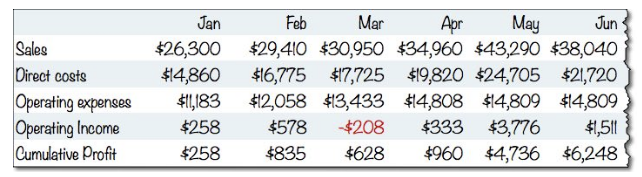
The first chart below shows key operating numbers for that store over a few months. You see sales, direct costs, expenses, and profits.

cash versus profits

Now we compare that to a simple cash flow projection based on the assumption that the store makes 90 percent of its sales on account (to be paid later) and its customers wait two months to pay those invoices (that would be unusual for a bicycle store, yes, but it’s the common case for most existing business-to-business companies).

Also, let’s assume Garrett keeps about a month’s worth of sales as products in the store, called inventory, that customers can buy, and he has to buy those products in advance of selling them. The result is cash flow vastly different from profits, as you can see in the following illustration:

cash versus profits

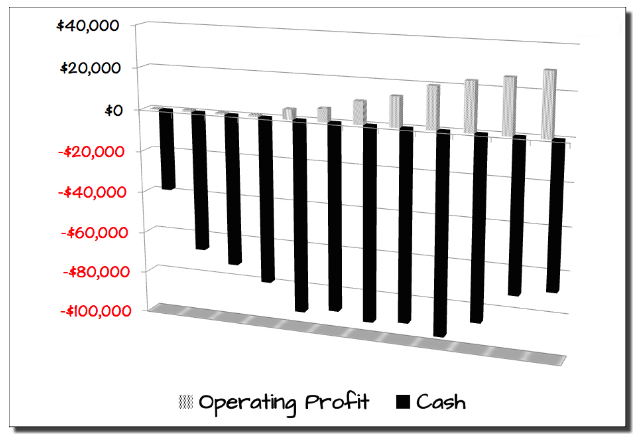
The difference between profits and cash, in this case, is more than $90,000 for a business selling about $30,000 monthly. That business would be profitable but bankrupt for lack of cash.

The change in the two scenarios is just cash flow, not a penny of sales, the cost of sales, or expenses. No prices are changed, no new employees added, and no changes made in salary.

Here’s what that difference looks like graphically:

cash versus profits

The real bottom line: Mind the cash flow

The phrase “the bottom line” is a reference to profits, which are the bottom line of the profit and loss statement. But it’s actually come to mean something like a conclusion, or the most important result. That’s why the real bottom line for business owners is cash flow, not profits.

Profitable companies can run out of money due to lack of cash flow. There’s no way around it: To run a business, you have to mind cash flow, not just profits.

Editor’s note: This article was updated in 2018.


from Bplans Articles https://ift.tt/2qj2tJC

Pros vs. Joes: What’s in the Bag (powered by Arccos)

After every PGA Tour event, golf fans can view a “What’s In The Bag” for the winner. Hyper-custom shafts and high-tech specs abound.

You can learn that Tiger Woods had a 9.5-degree TaylorMade M3 driver with a Diamana D+ White 70TX shaft when he won his 80th Tour event at East Lake. Even if you can’t relate to the specs played by the pros, you can still glean valuable information from their bag makeups.

In the latest installment of this series with Arccos, we’re looking at a WITB for amateurs and comparing it to the pros. What can you learn from the decisions pros and top amateurs are making with their 14 clubs?

Using the massive Arccos dataset – more than 100 million shots taken during nearly two million rounds – we’re able to analyze the bag makeup of a wide variety of amateur players. Arccos tracks all on-course performance data via sensors installed in the grips of clubs. The system automatically records and analyzes all of a golfer’s stats, uses Artificial Intelligence to show a personalized strategy for every shot, and leverages advanced analytics to inform practice regimens.

Analyzing full bag makeup across all user types, the most common 14 clubs for all amateurs are:

Seems fairly standard. Almost 16% of Arccos users – no matter their handicap – have this composition. Compared to the recent PGA Tour winners, the numbers are similar, but there’s variety in two key spots: the clubs between 3-wood and 4-iron and wedges.  Here are the clubs chosen at those key spots for the most recent PGA Tour winners of the 2018 season.

You’ll notice a few things right off the bat. First, there’s only one hybrid in the bunch (Keegan Bradley.) Next, there’s variety across the board in wedge composition, but there are almost always four wedges. Using Arccos data, we found that single-digit handicappers average 3.64 wedges. Comparatively, 20+ handicappers average only 3.23 wedges. This discrepancy may not seem like much, but it clearly shows that the best players – amateur and pro – lean toward having four wedges.

(One of the perks of having Arccos is the ability to easily spot underperforming clubs. A quick look at usage stats could show that you actually are hitting your 5-wood once a round but have a 30-yard gap in your pitching wedge and sand wedge. Easy fix!)

So far Arccos data has compared 4-irons and 4-hybrids, analyzed woods and hybrids for each handicap level and examined a pro’s bag makeup against amateurs. The overarching theme: decisions for each club that earns its way into your bag are personal, and you can only make educated and informed decisions through data. Knowing your shot data – club usage, proximity to the hole, Smart Distance – is available to all Arccos users for every club. Use data to your advantage and begin to see lower scores.


from MyGolfSpy https://ift.tt/2yFtLhD

Friday, October 26, 2018

Foresight Launches Educational Platform: PEAK

If knowledge is power, then launch monitors are golf’s nuclear energy. The sheer quantity of data these units can disseminate in fractions of a second is enough to overwhelm any general consumer, let alone certified teaching professionals. The information is generationally unique. Players even a decade ago didn’t have such universal access to this quality and quantity of club and ball data.

That said, information is meaningless if the end user can’t apply it in a way which helps themselves or others improve. As such, Foresight Sports, makers of the most accurate launch monitors in the industry (GCQuad, GC2 with HMT) launched a proprietary educational platform, titled PEAK (Performance. Education. Analysis. Knowledge.)

PLATFORM

PEAK Level 1: Launchpad Course is a series of three online modules (clubhead data, ball launch data, ball flight data) each of which is broken down into specific learning segments. Depending on how much background knowledge the student has with the material presented, each sub-topic requires 5-10 minutes to complete. The systematic presentation of content starts with video instruction featuring Foresight’s Director of Education, Liam Mucklow, which is followed by several animations for the more visually inclined learners. Pieces of text from instructors like Martin Hall and Butch Harmon are interspersed throughout each session as are several quiz questions to check for understanding.

The variety of presentation formats keeps the course moving at a reasonable pace, though there is some repetition in places. That said, most people taking this course are likely doing so to gain access to high-level information in an accessible and efficiently presented package. In this context, Foresight is working off the premise that engagement comes from the content, less than the delivery method.

From a pedagogical perspective, and keep in mind this is Foresight’s first foray into the educational environment, the questions and content felt, at times, out of order. Because 75% accuracy is required to pass each sub-section and move on to the next one (some of which have as few as three questions), it might make more sense to start each lesson with a list of key points which are then explored in depth and eventually followed by a quiz of at least 6-8 questions. If the primary purpose is formatting instruction so others can learn, a couple of tweaks might be in order.

CONTENT

As an introductory course, the primary objective is to explain the capabilities of Foresight’s bellwether offering, the GC Quad, which costs roughly $18,000. That said, owners of the GC2 (with or without HMT) will find the material just as applicable, and though it’s not required to own a Foresight launch monitor to enroll in the course, at an initial cost of $295, it might be too much for non-Foresight owners to stomach.

Without giving away too much, Foresight uses cameras and proprietary software to measure club data the instant before impact and ball data immediately after impact. Comparatively, radar-based systems, such as Trackman, use Doppler technology to track ball flight but have to extrapolate ball and club data. Camera-based systems have every advantage when it comes to indoor environments where limited flight is an issue and accuracy of ball and club data is paramount. Conversely, radar-based systems (Trackman) are both more expensive and space intensive. Trackman’s flagship model (Trackman 4) starts at $19,000 and if you want to use it indoors, add $6000 for simulator specific software. Because radar-based systems track ball flight, more horizontal and vertical space is required to get accurate readings.

Of the three primary topics in Level 1, the first segment on club head data is the most in depth. Foresight cameras (two in the GC2 and four in the GCQuad) use fiducials (small silver adhesive dots) to triangulate and precisely measure myriad pieces of data relative to club head speed, path, impact location, angle of attack, and impact loft (dynamic loft). Radar-based systems (Trackman) are primarily result-oriented (showing ball flight) and as such don’t have the capability to accurately produce data points like delivered lie angle, which is far more accurate than hitting off a lie-board and might help explain why you pull your wedges more often than your three-wood.

Moreover, because dynamic loft is measured based on the flat triangulated plane of fiducials, Foresight can account for bulge and roll in all metalwoods to give players a more accurate read on exactly how much loft the player is delivering to the ball at impact. There’s a lot to digest with respect to clubhead data, and realistically, this topic could merit its own advanced course offering. As such, we’ll save closure rate, the three axes of rotational velocity and normal vectors for paying subscribers.

The second section on ball launch data works to establish the underpinnings of how initial launch and spin contribute to ball flight. It introduces users to terms like azimuth and spin axis tilt. While the nomenclature can be a little intimidating at first – full disclosure, I repeated several of the mini-lessons to wrap my head around how face-to-path influences spin axis – the visual demonstrations provide much-needed clarity. The third and shortest topic covers calculated figures like apex (maximum height) and carry distance which while accurate, likely have more value in a clubfitting context than an instructional one.

There isn’t much inside the golf industry which is universally true, but the quest to shoot lower scores is a challenge shared by all. Improvement requires, more than anything, quality root cause analysis. In turn, the query is only as good as the data feeding it – or “junk in junk out” as my first computer science professor liked to remind us.

Commercial grade launch monitors and the knowledge base required to interpret the varied layers of data used to be reserved for teaching professionals, OEM R&D teams, and the engineers who created them. But now, launch monitors are becoming commonplace within the industry. Professional golfers use them for practice and on the range before competitive rounds. Consumers expect any clubfitter to have one on hand to help determine if an equipment change is in order, and competitive players – from elite amateurs to the B-flight club champion – all are now using data to find some measure of progress. At MyGolfSpy, we rely on Foresight products for all of our #Datacratic Most Wanted testing and product reviews. Because objective information is the foundation of how MyGolfSpy operates, it’s imperative we use the most accurate products available.

Creating shared language and a common understanding helps both the teacher and the student. It shifts the conversation toward one based on objective information, which still leaves plenty of room for conjecture and debate. That said, the primary challenge moving forward won’t be the existence of information, rather continued education which takes potentially complex information and simplifies it in a way which maintains the integrity of the data but allows players with even a basic understanding to digest it. No doubt, easier said than done, however, it seems a differentiated approach which perhaps offers truncated or “lite” version of some modules might be in order.

PRICING/AVAILABILITY

PEAK Level 1 is currently available at a flat rate of $295. PGA Professionals can receive 2 MSR credits for course completion, and the intention is to release PEAK Level 2 in the coming months. As the platform expands, the hope is users engage with one another via the connect online forum to extend conversations, post questions and interact with Foresight instructors and staff.

No doubt there will be critics who feel that reading divots and ball flight can tell players everything they need to know and while not entirely incorrect, it’s a bit like pretending taking a child’s temperature with the back of your hand is just as good as running a comprehensive metabolic blood panel. Because we know better, it means we can do better, though some will maintain too much information only creates confusion and analytical paralysis.

What do you think? Is golf’s new parlance the key to unlocking a more coherent and effective instructional environment or is an abundance of information too much of a good thing?


from MyGolfSpy https://ift.tt/2O7Erug

Wednesday, October 24, 2018

The Different Types of Business Plans

the different types of business plans

This article is part of our Business Planning Guide—a curated list of our articles that will help you with the planning process!

Business plans go by many names: Strategic plans, operational plans, internal plans, Lean Plans, and many others.

Lately, I’ve been focusing on the Lean Plan. There are also one-page business plans, although those are really more summaries. Of course, there are traditional business plans, which can also be called formal business plans, or wow-do-I-really-have-to-do-all-that business plans.

You might need different kinds of business plans depending on what you plan to use to accomplish. Like so many other things in business, the principle of form follows function applies. Different situations call for different types of business plans. An effective business plan will match its intended use. Knowing the specific use of a particular type of plan will help you build a better roadmap for the future of your business.

Download the Business Plan Template today!

Let’s take a look at the types of business plans and their differences. You can click on the link to be taken directly to the section on that specific business plan if you’d like to jump ahead.

In this article, I’ll cover these different types of business plans:

The Lean Plan: Track and grow

All businesses can use a Lean Plan to manage strategy, tactics, dates, milestones, activities, and cash flow.

The Lean Plan is faster, easier, and more efficient than a formal business plan because it doesn’t include summaries, descriptions, and background details that you and your partners or employees already know.

It’s most useful if you’re trying to grow your business and want to use it as a tool to track your financials and milestones against what you projected so you can respond to opportunity and react to challenges quickly.

A Lean Plan includes specific deadlines and milestones, and the budgets allotted for meeting them, so your team is up to speed.

A Lean Plan includes four essential elements—all of them functions of general business management:

1. Your guiding strategy

Use simple bullet points to define your target market, business offering, underlying business identity, and long-term goals. No additional text is needed. These serve as a reminder for owners and managers.

2. Tactics you’ll use to execute strategy

Use bullet points again. These include marketing decisions such as pricing, channels, website, social media, promotion, and advertising.

Product or service tactics also apply here, including pricing, launch dates, bundles, configuration, new versions, and delivery or packaging. Other tactics might define positions to recruit, training required, and so forth.

3. Concrete specifics to measure your progress

List of assumptions, milestones, objective measurements of performance, task responsibilities, and what numbers to track.

4. Essential numbers

This is your company’s basic financial plan, including your sales forecast, spending budget, and cash flow.

You can monitor each of these areas using basic excel spreadsheets, but a business dashboard that quickly and easily shows you the difference between your forecast and your actuals can save you time. Ideally, you have software that compares your plan to actual results automatically.

The value of the Lean Plan starts with the plan, but that’s just the beginning. Real management is steering your business with a Lean Plan that you review and revise regularly, tracking progress and performance, and making regular course correction.

You can download our free Lean Plan Template for a jump start on the Lean Planning process.

The standard business plan: Get funding

These days, the standard business plan is shorter than ever before, and it’s also just as likely to be an online document as it is to be printed. You’ll need to put together a stand business plan if you have a business plan event, which is what we call it when a business needs to present a business plan to a bank, prospective investor, vendor, ally, partner, or employee.

The most standard business plan starts with an executive summary and includes sections or chapters covering the company, the product or service it sells, the target market, strategy and implementation milestones and goals, management team, and financial forecasting, and analysis. The exact order of topics is not important, but most people expect to see all of these topics covered as part of the standard plan.

Think of your Lean Plan as a good first draft of a standard plan. Those complete projections include the three essential financial projections (also called pro-forma statements): profit and loss, balance sheet, and cash flow. Every standard business plan needs sales plus these three essentials.

The projected cash flow is an essential part of a standard business plan. Businesses need cash to stay open, period. Even if a business can survive temporarily without profits, it still needs the cash to pay its bills. And since profits alone don’t guarantee cash in the bank, projected cash flow is essential.

Many standard plans also include a table for personnel spending. Some standard plans will need additional projections to meet the needs of the specific business plan event. For example, plans for seeking outside investment should include a discussion of an eventual exit for investors, and of course the planned use of the invested funds. Plans supporting a bank loan application might include projected ratios the bank wants to see, such as debt to equity, quick, or current ratios.

You can download our free business plan template to complete your standard business plan. Bplans also offers a library of free, downloadable sample plans to give you a better sense of what the finished product will look like.

One-page business plan: A quick summary

Some people refer to what they call a one-page business plan. This is a one-page summary that includes highlights only, used to offer a very quick overview of a business.

It is possible to summarize the target market, business offering, main milestones, and essential sales forecast in a single page. Such a summary can be useful as a summary for banks, potential investors, vendors, allies, and employees. A one-page business plan can also be called a business pitch.

What kind of business plan does a startup need?

Every startup deserves a business plan to break out the steps and requirements with educated guesses for important lists and numbers.

The business plan for a startup is sometimes called a startup plan, but some people think all business plans are for startups, and that only startups use business plans. That’s not the case, as planning should be part of business management.

In most cases, the best kind of business plan for a startup is a Lean Plan that, includes projected startup costs, startup steps, and milestones. Startup costs include expenses incurred before launch, such as legal expenses, branding costs, like logo and graphics, websites, signage, and fixing up the office or store; plus assets required, such as starting inventory, vehicles, equipment, office furniture, and—the hardest to estimate and most important—starting money in the bank.

While the Lean Plan with extra startup information is fine for most startups, when a startup requires funding from banks or investors, then its business plan looks more like the standard business plan, including a discussion of exit strategies for investors, and almost always stating the planned use of the funds required.

You can use this startup plan to discuss your options with potential partners and associates. This kind of no-frills plan is good for deciding whether or not to proceed with an idea, to help gauge whether this is a business worth pursuing. If you do decide to go into business, over time you can always go back to your business plan and make necessary edits and additions. As your business grows, you can flesh sections out and add details.

When the startup plan will be read by outsiders, it’s common courtesy to add an executive summary, a company overview, management team, and descriptions of the market, marketing plan, and product plan. Even if you don’t have the exact numbers yet, it’s always a smart idea to include a preliminary analysis of costs, pricing, and probable expenses.

Is a startup plan the same as a feasibility plan?

Some experts use the phrase “feasibility plan” to mean the same thing as a startup plan. Others use it to refer to specific steps taken to validate a technology, product, or market. For example, the feasibility plan for a new kind of brick kiln might include the steps to establish a working version in a laboratory, then a small prototype in the field, and then a first working product.

A feasibility plan for a product solution for a new market might involve getting early users and validating the idea with people willing to pay money for it. In some cases a feasibility plan involves getting a product or service posted onto a site like Kickstarter or its competitors, offering the product in advance of availability to people willing to commit to buying it later.

Feasibility plans rarely include the full range of topics one would expect in a standard business plan or even a Lean Plan. They tend to be focused on whether or not a product will work or a market exists, without the additional strategy, tactics, and financial projections. However, the term is used differently by different people, so if you hear this term from someone or plan to use it yourself, it’s best to get clarification.

How is an internal plan different from a standard business plan?

Internal plans are for the most part another name for what we call a Lean Plan.

Like the Lean Plan, they will reflect the needs of the members of your company. Since the purpose of an internal plan is specific to the people directly involved with the company, it will most likely be shorter and more concise than a fully detailed standard plan that you’d take to the bank.

Internal plans are not intended for banks, outside investors, or other third parties.

Operations plan or annual plan: Track goals and monitor progress

Operations plans or annual plans tend to be a lot like a Lean Plan with another name. Like the Lean Plan, an operations plan includes specific implementation milestones, project deadlines, and responsibilities of team members and managers.

This is the plan used for staying on track to meet your goals as a business. Planning for your goals as a business allows your company to assign priorities, focus on results, and track your progress. Your operations plan covers the inner workings of your business. It outlines the specifics of who should be doing what, and when they should be doing it.

Of course, cash flow figures prominently here as well. For example, your milestones will need to have sufficient funding for their implementation, and you’ll need to track your progress so you know how much you’re spending.

A growth or expansion plan

These could be Lean Plans or even standard business plans, but focusing on a specific area of a business, or a subset of the business.

For example, a plan for the creation of a new product is a growth plan. These plans could be internal plans or not, depending on whether they are being linked to loan applications or new investment. An expansion plan requiring new outside investment would probably need to include full company descriptions and background on the product, market, and management team, just the same as a standard plan for investors would. Loan applications would require this much detail as well.

However, an internal growth plan used to set up the steps for growth or expansion that is funded internally could skip these descriptions, just like a Lean Plan. It might not be necessary to include detailed financial projections for the company overall, but it should at least include detailed forecasts of sales and expenses for the new venture or product.

Strategic plan

The strategic plan is yet another phrase that people use differently, depending on the exact context.

Usually, a strategic plan is an internal plan, but without much detail about specifics and financial projections. It generally goes into more detail on strategy and tactics than the Lean Plan does, so it has more description and explanation. However, strategy is useless without execution, so a good strategic plan has to take implementation into account, which means some consideration for resources and time.

As you build the strategy for your company and decide how to implement it, you will want to examine your strengths and weaknesses as a business—you should include a SWOT analysis in your strategic plan. Here are some SWOT examples.

What does your company do well? As your company grows, you want to play to your strengths. Strategy is often a matter of selecting the right opportunities. Resources should be funneled strategically to the areas where they will provide the biggest overall benefits.

Strategy plans are much more likely to be something for the larger enterprise, in which teams of high-level management and sometimes expensive consultants develop a broad-brush, high-level strategy.

In businesses that don’t have thousands of employees, strategy rarely exists in a vacuum and is almost always developed as part of a business plan, lean or standard. Once you have an idea of your strategy, you must have a plan for implementing it. This is where the milestones portion of the plan becomes key.

To effectively execute your strategies, it’s critical to assign responsibilities and have a schedule for following through. The implementation tactics you use will actively move you in the right direction toward achieving your goals. And that is essentially the function of a business plan.

Resources for moving forward

Reading about the different types of business plans is a good jumping-off point in the process of creating a business plan.

If you’re looking for more information about business plans and how to write them, you’ll find our sample business plan library and our guide to writing a detailed business plan to be helpful resources.

You might also want to check out our business plan template available through our software, LivePlan. Or, if you’d rather leave it up to the pros, you can always have an MBA write your business plan for you in five business days with LivePlan’s business plan consulting.


from Bplans Articles https://ift.tt/2O3hOHu

Shaft Review – Graphite Design Tour AD VR

shaft-trust-stripe-3

While I’m not what you’d call a fan of dropping temperatures and falling leaves, I do appreciate that autumn almost invariably brings with it the release of a new Tour AD model from Graphite Design. For the 2019 season, it’s the Tour AD VR.

Cosmetically, the VR (which, FYI, stands for Vanquish All Rivals) is everything you’d expect from the AD line. Colors may change, but Graphite Design maintains a consistent look. You know it’s an AD because it looks like an AD. While that means the graphics might not be as bold or ostentatious as others, it’s a dependable no-nonsense approach that seldom results in a color scheme anyone would consider an eyesore.

Now, I imagine you might be looking at the AD VR’s blue colorway and thinking that the AD VR must be a replacement for the popular AD BB. Not so fast, cowboy. While some of us would be totally onboard with that, Graphite Design describes the Tour AD VR as a slightly tweaked Tour AD IZ (which is a slightly tweaked Tour AD DI). Fans of the IZ (or the DI for that matter) shouldn’t freak out. Nothing is moving out of the lineup to make way for the new model. That’s not how Graphite Design does things. It can take fitters a couple of years to get comfortable with a shaft, so the company doesn’t find much value in yanking trusted models to make room for something unfamiliar. The Tour AD DI, for example, turns 9 this year, but it’s still in the lineup because the performance still holds up and it still moves the needle with golfers and fitters.

AD VR Performance Characteristics

Given how Graphite Design describes the VR, it’s reasonable to base our comparisons around the Tour AD IZ. The company says the AD VR has the softer tip of the two, but it’s important to remember that butt, middle and tip section measurements can vary tremendously based on how each section of shaft is defined by those taking the measurements. Using the Cool Clubs S3 data as our standard, you’ll see, the AD VR comes out slightly firmer in the butt and tip sections with a mid-section that’s just a bit softer. According to Graphite Design, the kickpoint on the AD VR has been pulled up slightly to promote lower launch. The collection of changes makes for a shaft that the manufacturer describes as offering mid/high launch and low spin.

As with last season’s IZ and 2017’s AD TP, the AD VR features FTT (Fast Taper Technology), which, according to Graphite Design, “incorporates a faster taper rate from the grip to the lower mid-section of the shaft, providing the overall feeling of greater clubhead control at impact and an increase in clubhead speed.” The AD TP (first to incorporate FTT) was included in low spin shaft test, and our results suggest FTT may contribute to tighter dispersion.

Materials

While I would actively encourage you not to obsess over materials, I’m obliged to tell you that the AD VR, like other recent AD models, is made primarily from 50T carbon fiber and uses T1100G to strategically stiffen sections of the shaft without adding weight.

For our CoolClubs S3-powered comparisons we’ve chosen the to show the VR alongside the IZ. We thought that made the most sense given how Graphite Design describes the VR. It’s also worth noting that in July of this year, IZ was the best-selling shaft in the Graphite Design lineup. It’s the first time in the better part of a decade that anything in the lineup has outsold the iconic AD DI.

GRAPHITE DESIGN TOUR AD VR: THE COOL CLUBS S3 COMPARISON

s3full

“S3 Technologies utilizes the most advanced shaft testing technology in the industry. The Shaft Simulation System (S3), which was developed in 2013, is a fully-automated, all-in-one shaft profiling machine. In a matter of minutes, the S3 determines the following shaft specs: (Straightness, Consistency Profile, EI Profile, CPM Analysis and Torque. While some of the aforementioned specs can be obtained from shaft manufacturers, a lack of industry standards prevents that data from being used for accurate apples-to-apples comparisons. S3 Technologies, solves this challenge by testing all of our production in-house using the S3. This gives S3 Technologies a unique and in-depth understanding of the quality and performance of the industry’s shafts.”

Not only does S3 give us standardized quantitative information about the shaft(s) being reviewed, the data we share will provide you with a much better sense of how those shafts compare with similarly spec’d offerings on the market today.

TOUR AD VR LAUNCH CHARACTERISTICS

Cool Clubs S3 classifies the 65g stiff AD VR as a mid launch shaft. By comparison, the AD IZ is classified as a mid-high launch shaft. In this comparison, Neutral (the Mid reference point used to classify launch parameters) and the database average for similarly spec’d shafts are almost identical. The takeaway is that the AD VR can be expected to launch a bit higher than similar shafts, but a bit lower than the Tour AD IZ.

Tour AD VR ZONE EI

The following chart compares the stiffness of the Tour AD VR to the Tour AD IZ in the butt, mid, and tip sections. Measurements are based on the stiff flex versions of the 65-gram model.

Because each shaft manufacturer defines zones a bit differently, it’s not unusual for S3 measurements to deviate from OEM descriptions. In this case, we see a stiffer handle section relative to the AD IZ with a slightly softer mid-section and a slightly firmer tip. The frequency measurements (not shown) are effectively equivalent.

EI Profile

This is the first time we’ve included a compared EI profile in a shaft review, but in this case, I believe it’s especially helpful for visualizing the differences between the two models discussed. Note that the curve is depicted from the butt (left side of chart) to the tip (right side of the chart).

The stiffer handle section of the AD VR is readily apparent, as is the slightly softer mid section and the slightly firmer tip.

The profile shape is indicative of a good portion of the of the Tour AD lineup. Individual models are more similar than different and most share the sloping profile depicted. The shape isn’t dissimilar to what you’d find in most Speeder models or the Diamana Blue. For what it’s worth, it’s a shape that generally works well for me.

What you should glean from all of this is that it is subtle differences in zone stiffness, balance point, and torque that truly differentiate the individual AD models.

AD VR BALANCE POINT

The following chart compares the balance point of the AD VR to the AD IZ. Measurements are based on the stiff flex versions of the 65-gram model.

The S3 data suggests that the balance point of the AD VR is the same as the AD IZ. Both the VR and the IZ have balance points that are slightly higher than the S3 Database average for shafts with similar specifications.

As you may recall from our Golf Geeks Story on Shaft Performance, a higher balance point allows for more head weight without drastically impacting the swingweight. For golfers seeking more distance (admittedly often at the expense of accuracy), this allows drivers to be built to longer playing lengths.

Swing Speed Recommendations

The chart below provides swing speed recommendations for the entire Tour AD VR lineup.

Note that these recommendations are based on the full range of Cool Clubs‘ building and fitting capabilities, including factors such as tipping and build length which can cause a shaft to play either softer or stiffer.

To simplify things a bit, you may wish to narrow these ranges. The sweet spot from a fitting perspective begins 25% from the slow end of the range. As a general rule, players with faster tempos, particularly in transition may fit into a stiff flex, while smoother swingers often fit into a softer flex.

From the Cool Clubs Fitting Team

For this discussion, we chose the VR-6 Stiff flex which is in the middle of the weight range for this shaft and compared it to Graphite Design’s IZ-6 S. The shafts both weigh 64.9 grams.

Consistent with their other shafts, the VR is made with high performance, high quality 50t carbon-fiber materials. They have continued to use their Fast Taper Technology, which differs from typical shafts in the amount of taper from the butt to the middle of the shaft. The iconic Graphite Design stripes are still readily visible and the rest of the shaft is very good looking in a deeper blue color with silver accents.

The GD Tour AD VR is designed as a mid-launch and mid to lower spin shaft. Available in a broad range of weights from 40 to 80 grams and flexes from R2 to X this shaft will fit a variety of players. The lighter VR-4 will launch the ball higher and spin more than the mid to heavier weight models.

When comparing launch the VR-6 is slightly lower than the IZ-6 but both are a little higher than the average launch of shafts in our database. Of these two shafts the VR-6 is stiffer than the IZ-6 in both the butt section and tip section. The shafts mirror each other through the mid section. The balance point is identical while the frequency is just slightly stiffer in the VR-6.

If you like the IZ-6 but want slightly lower launch and spin then the VR-6 is for you.

For more information on the Graphite Design Tour AD VR, visit Proschoicegolfshaft.com.


from MyGolfSpy https://ift.tt/2Apyp4Y